
Four-Flap Box
FEFCO 0201FEFCO 0201 — the most common type. A single blank, glued or stitched seam, four top and four bottom flaps.
Grades: T21–T24, P31–P32 · Profiles: B, C, BC · Flexo print up to 6 colours · Glued or stitched seam
We quickly find the optimal manufacturer for your packaging task and handle the entire process — from request to delivery. Wide range of corrugated packaging per GOST 7376-89 and FEFCO, plus ancillary materials for your warehouse and logistics.
GOST 7376-89 Standard
Interstate standard for corrugated board
FEFCO
International classification of box constructions
Grades D, T, P
2, 3 and 5-layer board
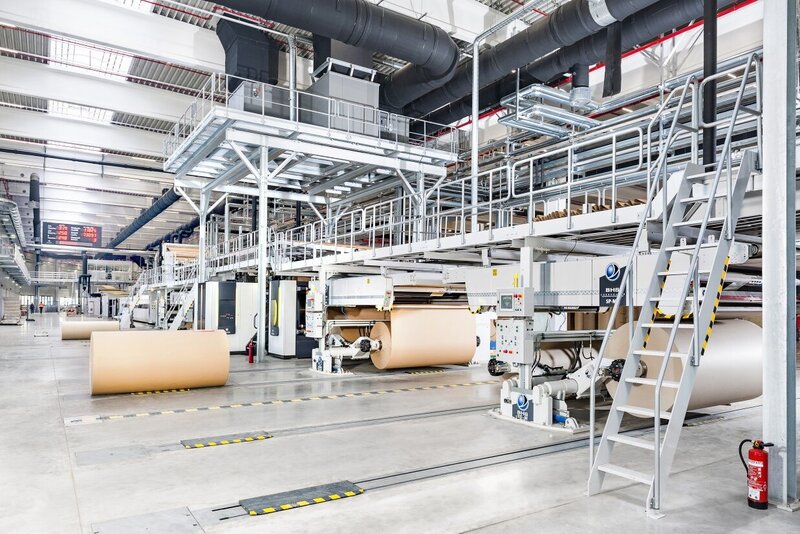
AlverPack production line
Corrugator — rotary slotter — flexo printing — gluing
Corrugated board is a multi-layer sheet material in which one or more layers of fluting paper are formed into a wave structure (flute) and glued to flat liner layers. It is precisely the flute that provides rigidity, cushioning and thermal insulation.
In Belarus and the CIS, production is governed by GOST 7376-89 "Corrugated board. General technical specifications". The standard defines the types (D, T, P), grades (T21–T27, P31–P37), flute profiles (A, B, C, E) and the norms for physical and mechanical properties.
2-Layer
Type D1 liner + 1 flute
Light wrapping and ancillary packaging
3-Layer
Type T2 liners + 1 flute
Main transport and consumer packaging
5-Layer
Type P3 liners + 2 flutes
Heavy loads, export and oversized boxes
We produce a wide range of corrugated packaging in FEFCO constructions from board of any grade per GOST 7376-89.
FEFCO 0201 — the most common type. A single blank, glued or stitched seam, four top and four bottom flaps.
Sheet corrugated board for interlayer pads, cradles and inserts. Supplied in sheets or rolls.
FEFCO 0310 — an open tray, folded from a single blank in one motion. Used in food, produce and bakery industries.
FEFCO 0421 — the bottom folds automatically during assembly. Saves time on the packing line.
FEFCO 0204/0306 — the lid slides over the body with overlap. Provides rigidity in storage and reliable protection.
Flexographic printing on kraft or white liner, lamination with design paper. For retail, marketplaces, street food.
Understanding the process helps you formulate the technical brief correctly and choose the optimal grade.
The board type (T or P), grade (T21–T24, etc.) and flute profile (A, B, C, E) are selected for the load and transport conditions. Profile C is the most universal: it balances cushioning and stacking strength.
From a product drawing or sample, a FEFCO construction code is chosen. The blank dimensions are calculated allowing for board thickness and process tolerances.
The corrugator forms the web. The rotary slotter cuts and creases (makes fold lines). Flexo printing is applied if needed. A semi-automatic or automatic folder-gluer assembles the blank.
Dimensional accuracy, gluing quality and print consistency are checked. Goods are palletised and labelled. Accompanying documents for accounting are supplied with the batch.
Characteristics from Table 2 of GOST 7376-89. ECT is the edge crush test along the flutes. This is the very indicator that determines a box's load-bearing capacity when stacked.
Composition: outer liner + flute + inner liner. The most common type. Grades T21–T27 in descending order of strength.
| Grade | ECT, kN/m (min) | Long. tear, kN/m | Application |
|---|---|---|---|
| T21 | 2.2 | 4 | Light items, inserts, ancillary packaging |
| T22 | 3.0 | 6 | Consumer goods, cosmetics, paper products |
| T23 | 3.8 | 7 | Food, household chemicals, universal transport packaging |
| T24 | 4.6 | 8 | Relatively heavy or fragile goods, reinforced transport packaging |
| T25 | 5.4 | 9 | Industrial parts, metalware, machinery |
| T26 | 6.2 | 10 | Heavy loads, spare parts, export packaging |
| T27 | 7.0 | 11 | Maximum strength for 3-layer: large industrial loads |
* Data from Table 2 of GOST 7376-89. The specific flute profile (A, B, C) is chosen separately and affects sheet thickness and cushioning, but not the grade.
Composition: 3 liners + 2 flutes. Significantly higher rigidity and stacking load-bearing capacity compared to T. Grades P31–P37.
| Grade | ECT, kN/m (min) | Long. tear, kN/m | Application |
|---|---|---|---|
| P31 | 3.8 | 7 | Medium loads with high storage stacks |
| P32 | 4.6 | 8 | Food, pharmaceutical and household industries |
| P33 | 5.4 | 9 | Oversized goods and equipment |
| P34 | 6.2 | 10 | Heavy industrial loads, export packaging |
| P35 | 7.0 | 11 | High-load export and warehouse packaging |
Type D — 2-layer
One liner + one flute. Used for wrapping and ancillary packaging, pads and cradles inside boxes. The standard defines grades D11–D16.
* Source: GOST 7376-89, Table 2. Grades P36 and P37 are provided by the standard and produced on request.
The profile defines the height and pitch of the fluting wave. The same board grade, for example T23, can be produced with profile B, C or BC — the choice affects cushioning, rigidity and print quality.
Coarse
Height: 4.4–5.5 mm · Pitch: 8–9.5 mm
Maximum cushioning. Fragile goods, glass, ceramics. Stacks well. Printing is difficult.
Fine
Height: 2.2–3.2 mm · Pitch: 4.5–6.4 mm
High rigidity. Canned and food goods. Excellent surface for flexo printing and die-cutting.
Medium
Height: 3.2–4.4 mm · Pitch: 6.5–8 mm
Universal. Balance of cushioning and stacking strength. The most common.
Micro
Height: 1.1–1.6 mm · Pitch: 3.2–3.6 mm
Thin board, smooth surface. Display, consumer and gift boxes.
Double
B + C profile in one sheet (5-layer)
5-layer combo. High rigidity and cushioning at once. Electronics, equipment.
FEFCO (European Federation of Corrugated Board Manufacturers) is an international system of box construction codes. It describes any box type unambiguously in any language. We produce all common constructions.
Trays, pads, inserts, grids, separators. Codes 0100–0199.
Made from a single blank; the seam is glued, stitched or taped. The most common class: FEFCO 0201 — the four-flap box. Codes 0200–0299.
Consist of two or more parts (body + lid). Overlap depth on request. FEFCO 0310, 0320, 0340. Codes 0300–0399.
The bottom is hinged to the walls. Erected in one motion. Widely used in the food industry. Codes 0400–0499.
The bottom folds automatically. Top flaps are closed by hand or machine. FEFCO 0421, 0427. Codes 0500–0599.
End walls are inserted separately, fastened with stitches. High rigidity. Codes 0600–0699.
Supplied fully assembled — just unfold. FEFCO 0701 and others. Codes 0700–0799.
Partitions, cradles, grids, sleeves. Hold the contents inside the box. Codes 0900–0999.
Standard transport box. Single blank, glued seam. Top flaps meet in the centre. The most common construction in the world.
Transport packaging, e-commerce, food, industry
The lid covers the base entirely. Fixed overlap length. Provides a double wall around the perimeter.
Electronics, glass, high-centre-of-gravity goods
The lid fits over the body at any depth. Lid height on request. Often used together with 0300 (base).
Premium goods, gift packaging with top access
A box without top flaps — an open tray. Simple construction, minimal board. Often used as a base under goods.
Fruit, vegetables, bakery, glassware
The bottom locks automatically when unfolded. Top flaps closed by hand. Speeds up manual and semi-automatic packing.
Logistics, warehouses with manual packing
Partitions and cradles made of corrugated board. Hold items in cells, prevent collision.
Bottles, cans, vials, fragile items
Specify the product type and dimensions — our manager will calculate the cost and contact you.
We will get in touch with you shortly.